Moving Forward Family Services (MFFS) is a non-profit offering counselling and social work practicum placements for counselling students. As their practicum program has grown, an onboarding process that once worked well has started to break down, creating logistical bottlenecks that left students without the support they need and burdened executives and supervisors with administrative overhead. I partnered with stakeholders to uncover the root causes of these pain points and redesign the onboarding experience.
Service Designer
Workshop Facilitator
UX Researcher
3 months
Aug 2021 – Oct 2021
Moving Forward Family Services
Moving Forward Family Services (MFFS) has taken on a growing number of practicum students each year. Their onboarding process wasn’t built to scale, creating logistical bottlenecks and leaving students without the clarity and support they needed to start their placements successfully, and burdening executives and supervisors with administrative overhead.
MFFS is a volunteer-run organization. Human resources to facilitate student onboarding and orientation are limited.
Through interviews with interns, supervisors, and the director, I identified the root causes behind the onboarding breakdowns. I then facilitated a co-design workshop with stakeholders to develop solutions, translating these insights into a strategy and implementation roadmap.
I began by meeting with MFFS’s executive director to discuss the pain points he’d observed and identify where the onboarding process could be strengthened. Together, we defined three goals to guide the work:
This early alignment gave us a shared foundation, and I returned to these goals throughout the project to check that my direction stayed on track.

I conducted interviews with six students and one supervisor to understand the practicum process from their perspective. Beyond gathering insights, these conversations became a point of connection; several students expressed gratitude simply for meeting face-to-face, noting I was the first person from the organization they’d interacted with outside of email. This was an early signal that MFFS’s onboarding lacked human connection, likely amplified by the COVID-19 pandemic.
Information was hard to find. Students couldn’t locate what they needed on the website, so they turned to emailing staff directly, often receiving no reply, or being redirected back to a website that hadn’t answered their question in the first place.
Roles and expectations weren’t clear. Students needed better communication about roles, responsibilities, and expectations to feel prepared, and supervisors needed the same clarity to support them effectively.
Orientation was overwhelming. The orientation process felt long, disorganized, and hard to navigate.
During the interviews, two words kept being repeated by students: confidence and connection.
How might we make students feel confident and connected?
With this question as our north star, I facilitated a workshop with the executive board.
I opened by outlining the goals for our time together:
I then built an agenda designed to move us through each goal in sequence.
We opened with an empathy map to warm participants up and shift them into a mindset of thinking from the student’s perspective before diving into solutions.
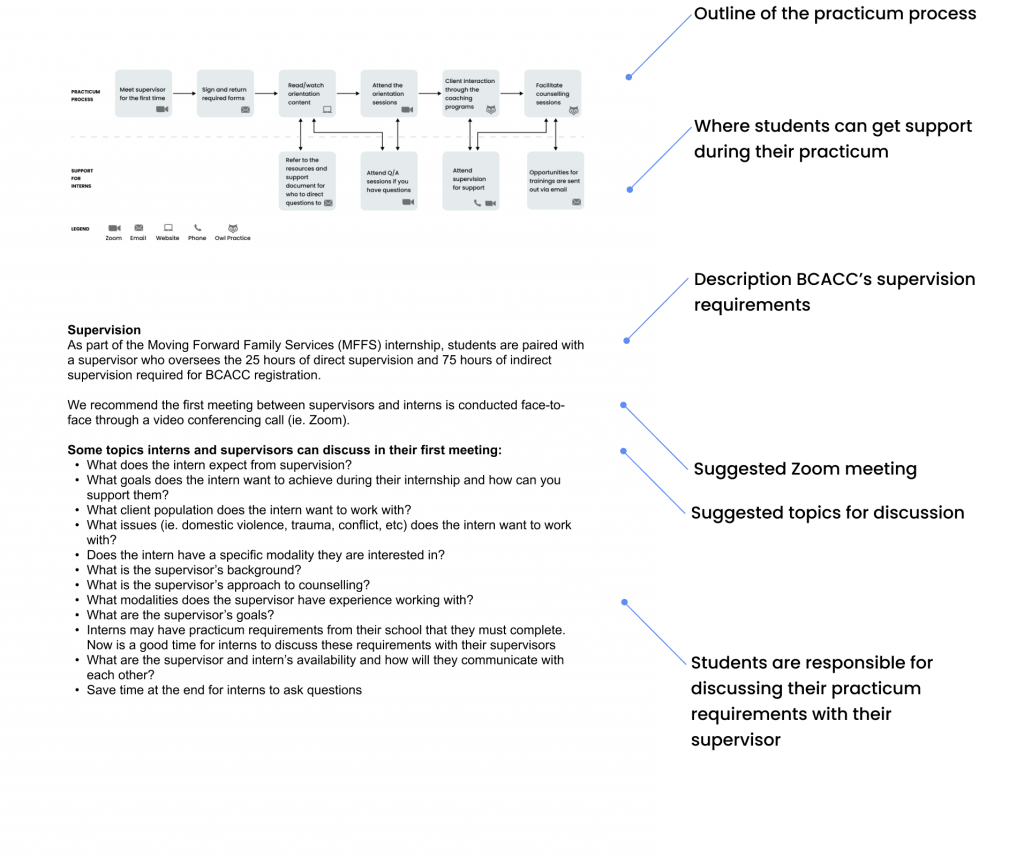
A Breakthrough moment was discussing the service blueprint. It was the first time stakeholders had seen their process laid out end-to-end, and the reaction was immediate: they asked if a version of the blueprint could be shared directly with students and supervisors to give everyone a clearer picture of how the organization actually worked.
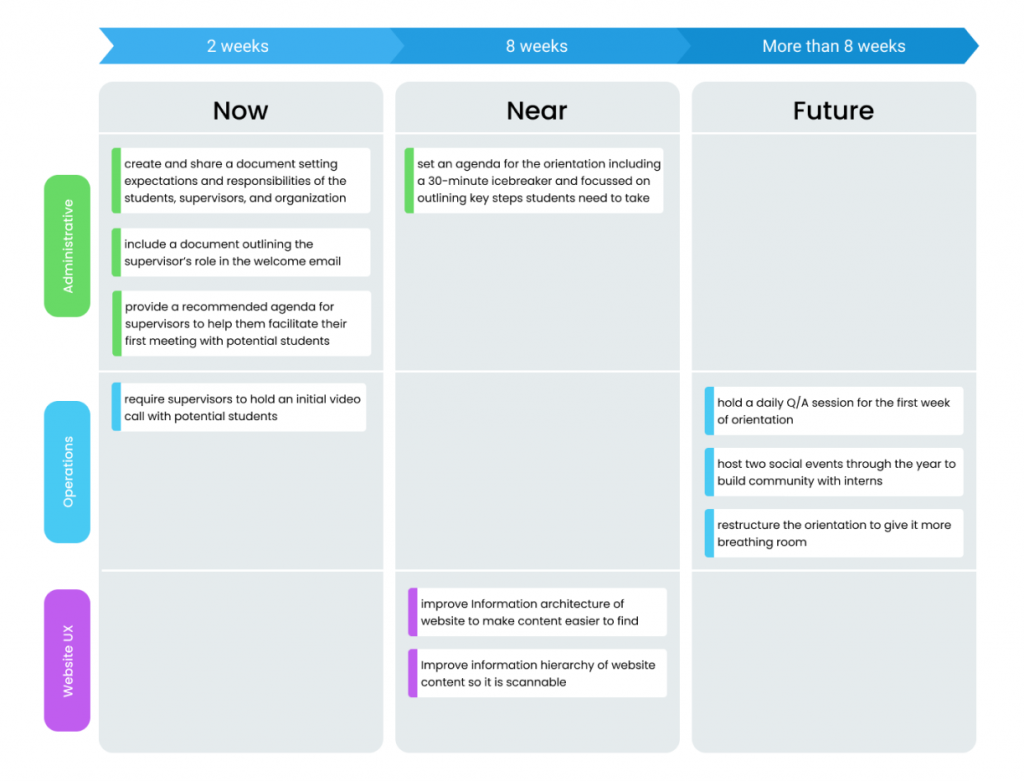
With a shared understanding of the process in place, we brainstormed solutions together and prioritized them using a decision-making matrix. From there, we built a project roadmap with clear milestones for when each change would be implemented.
“
The student-supervisor fit is an open and ongoing dialogue
-SUPERVISOR
Throughout the workshop, one theme kept surfacing: supervision. The executive director explained that the student-supervisor relationship is the foundation of the practicum experience — when that relationship starts strong, everything else follows.
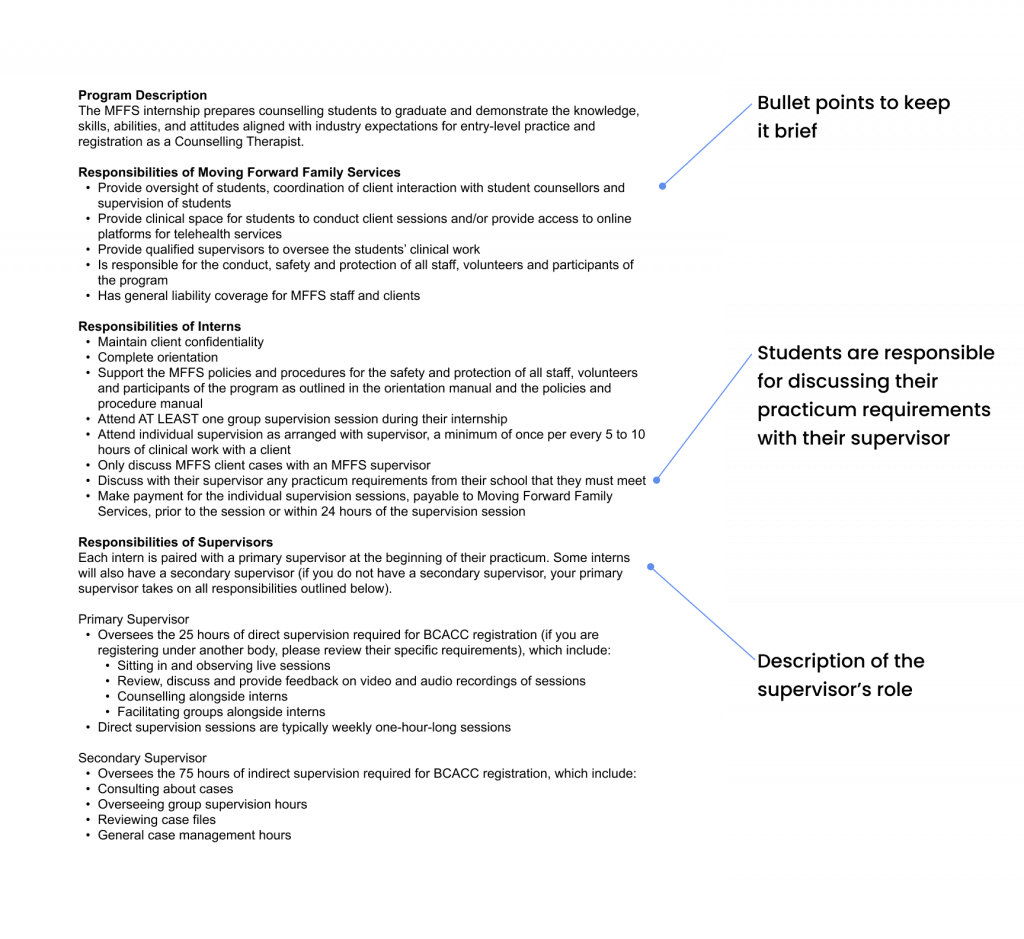
I designed two documents to be sent to new students and supervisors before their placement begins:
Stakeholders were so struck by how clearly the service blueprint captured their process that they asked to share it with students and supervisors directly. In response, I designed a simplified flowchart of the practicum process for that purpose.
Usability testing showed these documents would:
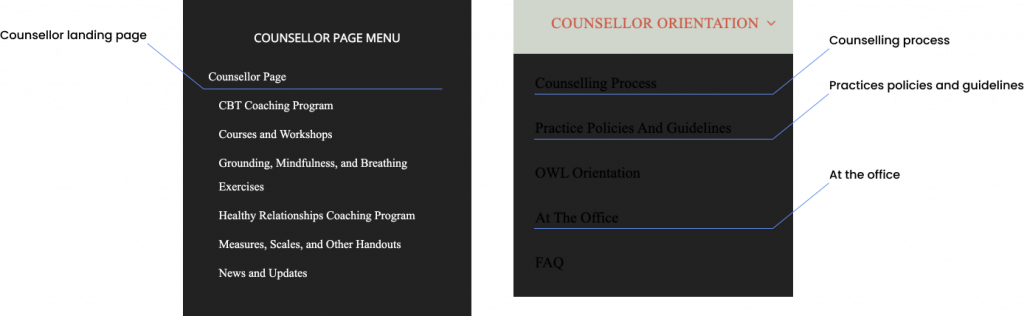
MFFS’s original information architecture split student orientation content across two tabs — Counsellor Page and Counsellor Orientation — with little logic guiding what lived where. Given the volume of content, I focused my efforts on the areas stakeholders identified as generating the most frequently asked questions.
I ran an initial tree test to establish a baseline, then used a card sort to inform a new information architecture. After a final round of tree testing to validate and refine the structure, I arrived at the version below, shown here as a zoomed-in view highlighting just the changes made.